
Why maintenance keeps failing when maintenance history is lost
Why maintenance fails even when everyone agrees. Lost maintenance history causes repeated breakdowns, forgotten fixes, and preventable downtime.
12/2/20252 min read

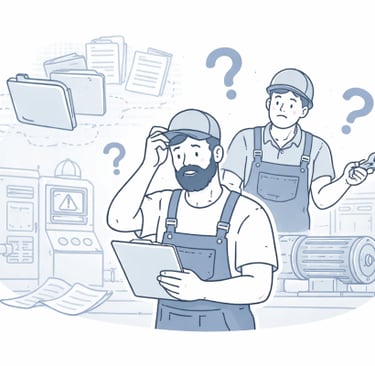
Every workplace eventually has the same moment.
Something breaks.
People are frustrated.
Everyone agrees it should not have happened.
Someone says we need a better system.
Everyone nods.
Then time passes and nothing really changes.
A few weeks or months later, the same thing breaks again.
I see this pattern everywhere. Factories. Warehouses. Rental properties. Churches. Small businesses. Different environments, same outcome.
The problem is rarely laziness or lack of intelligence.
It is memory.
The real issue no one names
What stood out most when I read people talking about maintenance problems was not disagreement. It was how quickly everyone related.
The jokes came fast. Not because it was funny, but because it was familiar.
People were not asking if this happens. They were sharing stories about how often it happens. Equipment that was fixed recently but no one remembers when. Parts that were replaced but no one knows why. Decisions that made sense at the time but were never written down.
The frustration was not about effort. It was about having to rediscover the same answers over and over again.
That is not a motivation problem.
That is a memory problem.
Why heavy systems often fail
The next thing that always happens is someone suggests a big solution.
Maintenance software.
Spreadsheets.
Shared folders.
A custom database someone built years ago.
What is interesting is how often these suggestions come with conditions.
It works if people stay disciplined.
It works if one specific person maintains it.
It worked in one place but not another.
Those conditions matter.
Most systems fail not because they are bad, but because they depend on perfect behavior. They assume people will always remember to update them, care enough to document things properly, and never leave or get overwhelmed.
Real life does not work that way.
When a system depends on vigilance, it eventually breaks down.
This is why many teams end up relying on spreadsheets or CMMS tools and still feel like maintenance tracking never quite sticks.
The missing layer
What almost no one says out loud is what is actually missing.
Continuity.
When someone new steps in, there is no clear history. When something breaks again, there is no quick way to see if it is related to last time. When a decision is questioned, the reason behind it is gone.
So people compensate.
They ask around.
They search emails.
They dig through old files.
They guess.
That guesswork is expensive. It costs time, money, and trust. And it is why the same problems keep resurfacing.
A quieter approach
After watching this cycle repeat enough times, I stopped looking for something bigger and started looking for something simpler.
Not a system that manages everything.
Just a place where basic maintenance history does not disappear.
Something you can save once and trust will still be there later. A note about what was replaced. A date that does not rely on memory. A short explanation of why a decision was made.
No dashboards to babysit.
No processes to enforce.
Just a record that survives people getting busy.
That shift is what led to RepairBucket.com
The shift that actually helps
The change this creates is subtle but powerful.
When history is easy to find, people stop arguing about what they think happened. They stop rebuilding context from scratch. Decisions feel calmer because they are informed.
Maintenance stops feeling like a constant emergency.
Fewer things fall through the cracks.
Fewer problems repeat for no clear reason.
Nothing about the work becomes more complicated. It actually becomes lighter.
That is what those conversations reveal more than anything. People are not resistant to maintenance. They are tired of carrying it in their heads.
When memory lives somewhere reliable, the rest starts to work again.