
Prevent repeat maintenance failures a practical guide
A practical guide to prevent repeat maintenance failures by preserving maintenance history reducing guesswork and avoiding the same problems returning
12/30/20253 min read
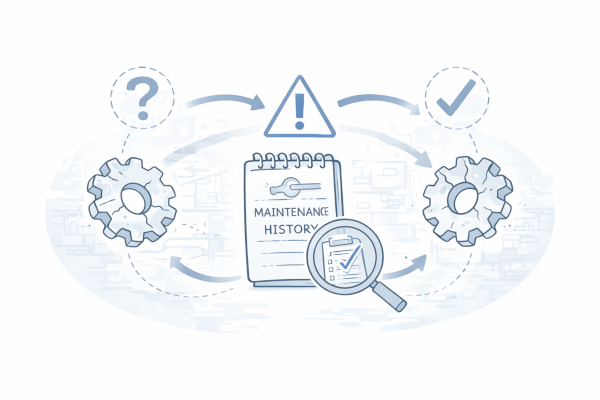
Most maintenance problems do not start with neglect.
They start with good intentions.
Something breaks.
Someone fixes it.
Everyone moves on.
The failure is not the repair.
The failure is what gets lost afterward.
This guide is based on patterns I keep seeing in real conversations between people who do this work every day. Engineers, operators, managers, and technicians who have lived through the same cycle enough times to joke about it.
If that sounds familiar, this guide is for you.
Step one. Admit the real problem is memory
One thing that stood out immediately was how quickly people agreed on the pain.
Not debating. Not theorizing. Just recognition.
Everyone had a story where something was fixed recently but no one could say when. Or a part was replaced but the reason was forgotten. Or a workaround became permanent because the original context disappeared.
This is not a failure of effort.
It is a failure of memory.
Once you name that clearly, the problem becomes easier to address.
Step two. Stop trying to fix everything at once
A common reaction to recurring maintenance issues is to go big.
New software.
New processes.
New rules.
The problem is that most teams try to jump straight to a full system before they have reliable history.
That is when people get overwhelmed. Updates get skipped. Trust in the system erodes. The tool slowly stops being used.
Several people described systems that worked only as long as one specific person cared deeply enough to maintain them.
That is not a scalable solution. It is a single point of failure.
Step three. Capture context while it still exists
One quiet mistake teams make is waiting until later to write things down.
Later rarely comes.
The most useful information is often the smallest. A quick note about why a decision was made. A date that anchors memory. A reminder that something was already tried.
You do not need perfect documentation. You need continuity.
If someone else reads it six months from now and understands what happened, it worked.
Step four. Make ownership visible without blame
Another pattern that showed up repeatedly was diffusion of responsibility.
Everyone thought someone else knew.
Everyone assumed it was handled.
Everyone laughed after the fact.
Ownership does not mean blame. It means clarity.
When it is clear who is responsible for capturing or updating context, history survives longer. When no one owns it, it disappears quietly.
The goal is not enforcement. The goal is visibility.
Step five. Design for tired people, not ideal ones
The best insight buried in those conversations was this.
Systems that only work when people are disciplined eventually fail.
People get busy.
People get tired.
People move on.
A system that requires constant vigilance will break under normal conditions.
A system that still works when people forget is the one that lasts.
That means fewer fields.
Shorter notes.
Less friction.
Step six. Grow complexity only when it earns its place
Once basic history is reliable, everything else becomes easier.
Scheduling makes more sense when you know what happened last time. Automation helps when the data is trusted. Reporting matters when the foundation is solid.
Trying to build complexity on top of missing memory just amplifies chaos.
You cannot automate what you do not remember.
What changes when memory is external
The biggest shift is not technical.
People stop guessing.
Arguments get shorter.
Decisions feel calmer.
Maintenance stops feeling like a series of emergencies and starts feeling manageable.
Not because nothing breaks.
But because the past is no longer invisible.
The quiet takeaway
Most teams are not broken.
Their memory systems are.
You do not need to start with a perfect maintenance platform. You need a way to stop losing the past.
Save a little.
Save it consistently.
Make it easy to find.
That is how repeat failures actually stop.
This guide exists because maintenance keeps failing in predictable ways when history is lost, even when everyone agrees on what should happen.